Section 1 · Design Thinking
The Design Thinking Process
- Definition
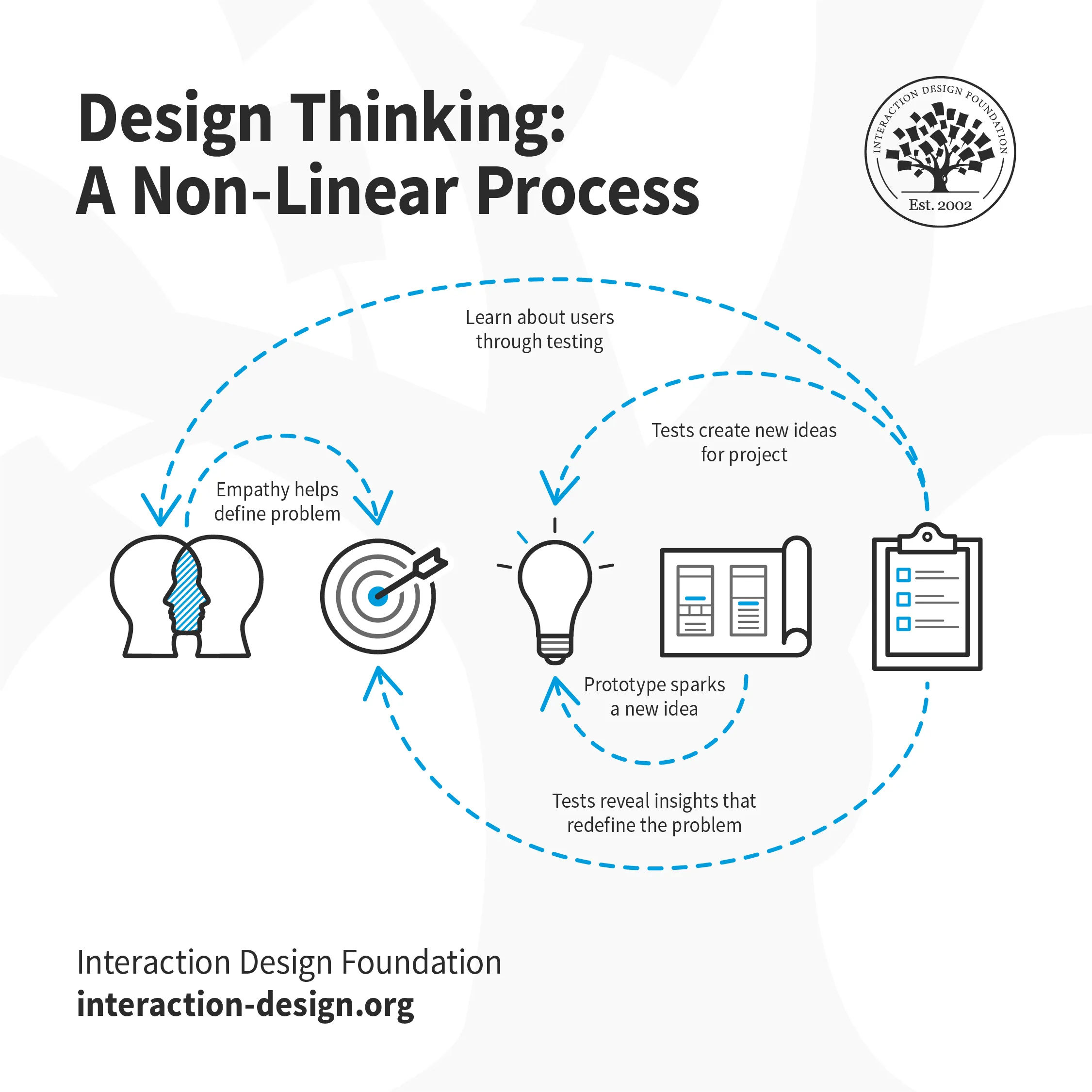
A human-centered, iterative framework for solving problems by understanding people’s needs before proposing solutions. Its most common form runs through five stages — Empathize, Define, Ideate, Prototype, and Test — worked through in sequence but revisited freely rather than marched through once.
© Teo Yu Siang and the Interaction Design Foundation, CC BY-NC-SA 3.0 - Why it matters
It keeps the work anchored to a real person’s need instead of the designer’s first idea. Jumping straight to a solution is the default failure; the process exists to hold that impulse off long enough to understand the problem it is meant to solve.
- Example
© Salvador Orara, CC BY-NC-SA 4.0. - Note
It’s easy to read the five stages as a checklist to complete once, top to bottom. The stages are non-linear: a test that fails sends you back to Define, or even Empathize, and that return is the method working rather than a setback. Picture it as a loop with arrows running backward, not a staircase.